Carrozzeria Ghia: A Legacy of Elegance
Founded in 1916 in Turin by Giacinto Ghia, Carrozzeria Ghia quickly established itself as one of Italy's most prestigious coachbuilding houses. For decades, Ghia shaped the automotive landscape with designs that married Italian artistry with engineering excellence, collaborating with manufacturers from Fiat and Alfa Romeo to Chrysler and Volkswagen.
After Giacinto Ghia's passing in 1944, the company was led by several figures, most notably Luigi Segre, who steered Ghia through its golden age in the 1950s. Under Segre's direction, Ghia produced some of the most celebrated one-off designs and concept cars of the era, including the Chrysler Ghia series and the iconic Volkswagen Karmann Ghia — a car whose design originated from a Ghia proposal.
By the early 1960s, Ghia was at the height of its prestige but also at a crossroads. The company needed a production model that could sustain its operations beyond one-off commissions and design studies. The answer would come from a partnership with Fiat.
Sergio Sartorelli: The Designer
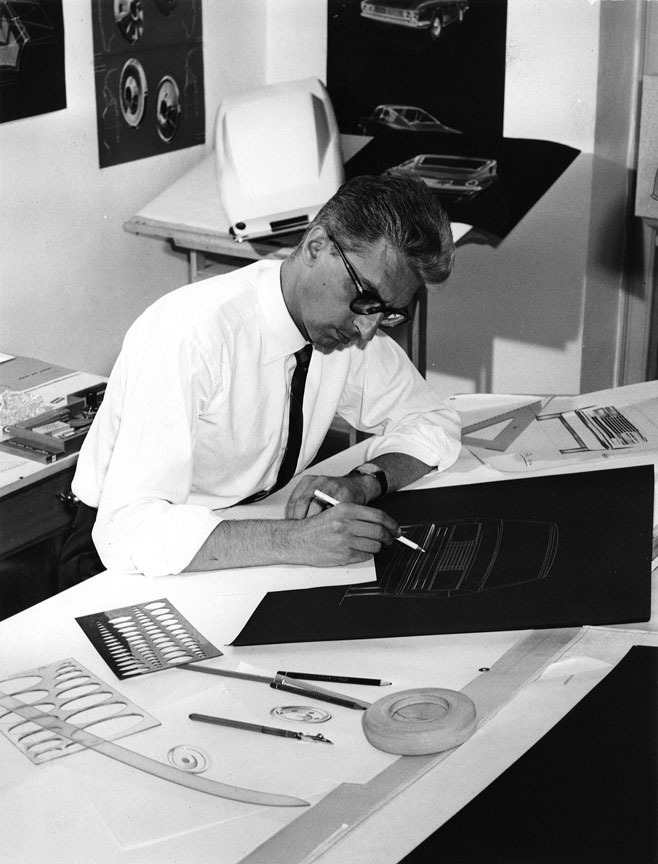
Sergio Sartorelli (1928–2006) was the talented designer responsible for the Ghia 1500 GT's elegant lines. A graduate of Turin's Polytechnic, Sartorelli joined Ghia in the late 1950s and quickly proved himself with a series of distinctive designs.
Sartorelli's design for the 1500 GT was a masterwork of restrained elegance. The car featured a long hood flowing into a compact greenhouse, with clean, taut surfaces that caught the light beautifully. The front end was distinguished by quad headlights set into a refined grille, while the rear featured a distinctive fastback profile with a large, curved rear window.
The design was first shown as a prototype at the 1962 Turin Motor Show, where it received immediate acclaim. The car's proportions were remarkably harmonious — it looked both powerful and refined, sporting yet suitable for grand touring.
The Ghia 1500 GT: Birth of a Gran Turismo
The Ghia 1500 GT was based on the mechanical components of the Fiat 1500, a popular mid-range sedan. Fiat supplied the running chassis complete with engine, gearbox, and suspension to Ghia's workshops in Turin, where the coachwork was hand-built and fitted.
Under the hood sat Fiat's reliable 1,481 cc inline-four engine, producing approximately 80 bhp in standard form. While not a powerhouse, the engine provided adequate performance for a comfortable GT car, with a top speed of around 170 km/h (106 mph). The car used a four-speed manual gearbox with column or floor shift, depending on the series.
What set the Ghia 1500 GT apart was not raw performance but the quality of the driving experience. The car offered:
Refined Comfort
A well-appointed interior with quality materials, comfortable seating for two plus occasional rear seats, and excellent visibility from the large glass area.
Elegant Design
Hand-crafted bodywork with attention to detail in every panel gap, chrome accent, and interior trim piece — the hallmark of a true carrozzeria product.
Reliable Mechanicals
Based on the proven Fiat 1500 platform, the car benefited from Fiat's extensive dealer network and readily available spare parts throughout Europe.
Exclusivity
With limited production numbers and hand-built construction, each Ghia 1500 GT was a far more exclusive proposition than mass-produced competitors.
Production: 1963–1965
Ghia showed the prototype at the Turin Motor Show in November 1962; series production ran from 1963 to 1965. The exact number built has long been debated, but the most commonly cited figure is approximately 846 units.
The model is often described as a 1962–1966 car, and both dates are defensible — the first counts the show car, the second the last first registrations. The three dates that matter are simply not the same: Fiat stamped the chassis, Ghia finished the body months later, and the first owner registered the car later still. Among the cars documented here, the Fiat chassis were delivered between 1962 and 1964, while the papers show first registrations spread from 1963 to 1968. See the chassis number guide for how a chassis is dated.
The car was offered in a range of colors. Red is by far the most common among the surviving cars documented here — a quarter of them — followed at some distance by blue, grey and white, then beige, black and the occasional green or gold. Some special examples were finished in unique colors or featured bespoke interior specifications.
Throughout the production run, the car underwent subtle refinements. Early cars (sometimes called "Series 1") can be distinguished from later examples by details such as the dashboard layout, trim elements, and mechanical specifications. However, as with many low-volume Italian cars of the period, there was considerable variation even within the same production series, as modifications were often implemented gradually on the production line.
1962 — Turin Motor Show Debut
The prototype is unveiled at the Salone dell’Automobile di Torino in November. Its Fiat chassis, #0071661, dates to May 1962 — the gap between the two is the coachbuilding. It remains the only chassis in the registry from that year.
1963 — Production Begins
Series production starts. Fourteen cars in the registry carry a chassis from this year, from #0180754 to #0285500. Cars are exported throughout Europe and to select markets worldwide, and the model gains a following among drivers seeking Italian style with practical reliability.
1964 — The Main Year
By far the best represented year: 48 of the 63 identified cars carry a 1964 chassis, from #0301398 to #0394674. Subtle updates are introduced, including interior refinements. Many of these chassis were bodied and registered in 1965 or 1966.
1965 — End of Production
Production winds down as Ghia shifts focus to other projects; Luigi Segre’s death in 1963 had already changed the company’s direction. No chassis above #0431661 — the first number of 1965 — has been recorded on a Ghia 1500 GT, which places the last bodies on chassis delivered in 1964. Their papers, however, run as late as 1968.
Legacy & Rediscovery
For decades after production ended, the Ghia 1500 GT remained largely forgotten — overshadowed by more famous Italian GTs from Ferrari, Maserati, and even Fiat's own Dino. Many cars were used as daily drivers and eventually discarded or left to deteriorate.
In recent years, however, the Ghia 1500 GT has experienced a remarkable rediscovery. Collectors and enthusiasts have come to appreciate the car's elegant design, its rarity, and the quality of its construction. Well-restored examples now command real attention at concours events and classic car gatherings, though the auction results of the last few years have been uneven — see the market page.
This registry exists to support that rediscovery — to ensure that as many surviving Ghia 1500 GTs as possible are documented, photographed, and their histories preserved for future generations of enthusiasts.
Technical Specifications
| Manufacturer | Carrozzeria Ghia, Turin, Italy |
| Designer | Sergio Sartorelli |
| Production | 1963–1965 (approx. 846 units, prototype 1962) |
| Body Style | 2-door coupé (2+2) |
| Engine | Fiat 1481 cc inline-4, OHV |
| Power | ~80 bhp at 5,200 rpm |
| Gearbox | 4-speed manual |
| Top Speed | ~170 km/h (106 mph) |
| Wheelbase | 2,420 mm |
| Length | 4,280 mm |
| Width | 1,555 mm |
| Weight | ~1,050 kg |
| Chassis | Fiat 1500 monocoque with Ghia body |